Hidden Costs in Sheet Metal Fabrication: 10 Factors That Inflate Your Quote
Hidden Costs in Sheet Metal Fabrication: 10 Factors That Inflate Your Quote
If you’ve ever sent the same drawing to two shops and got prices that looked like they were for different parts, you’re not imagining it. Sheet metal pricing can vary a lot — and it’s not always the most expensive quote that’s a rip-off.
This guide breaks down what actually drives the cost of a fabricated sheet metal part, and the hidden factors that inflate a quote so you can compare fairly and negotiate smartly.
The honest cost breakdown
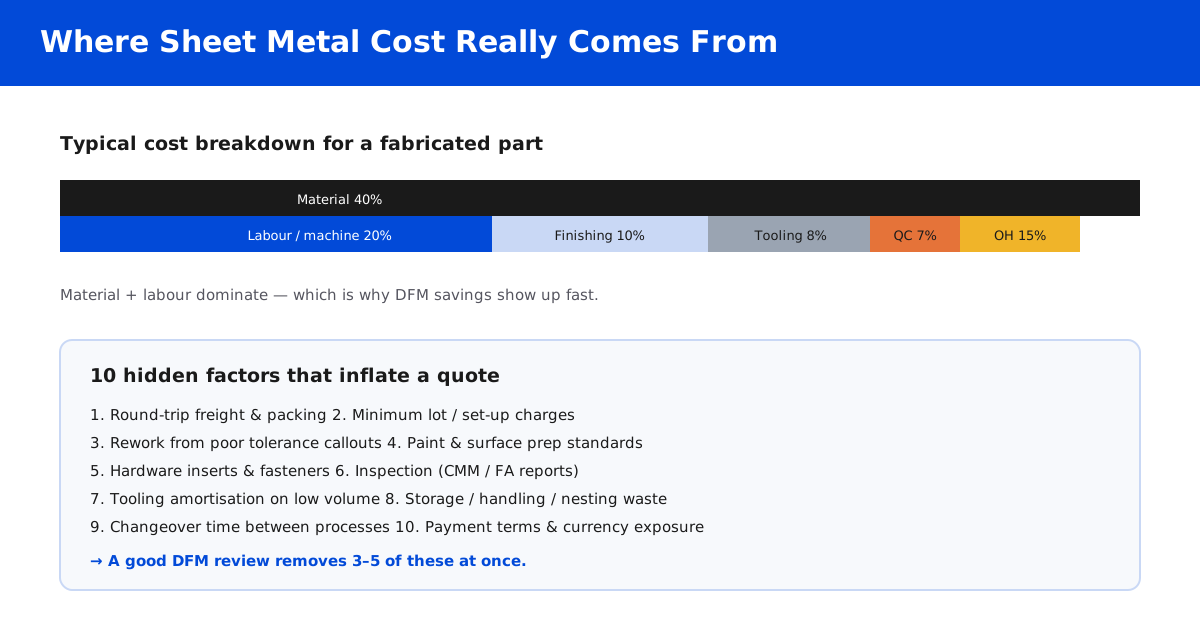
For a typical fabricated steel part, the cost usually splits roughly like this:
- Material ~40%
- Labour & machine time ~20%
- Overheads ~15%
- Finishing ~10%
- Tooling ~8%
- Quality control ~7%
Material and labour dominate. That’s why good DFM saves money fast — it cuts both at once.
The 10 factors that quietly inflate a quote
1. Round-trip freight and packaging
Shipping is real money, especially for large or heavy parts. A part that looks cheap per unit can be expensive once you count freight, crating, and handling. Compare landed cost, not unit price.
2. Minimum lot and set-up charges
Sheet metal has set-up time regardless of quantity. On a small run, that set-up is spread over few parts, so unit cost is high. Ask about the break-even quantity before you commit.
3. Rework from poor tolerance callouts
Every feature you over-tolerance costs money to hold and to check. Loosening functional tolerances can cut costs dramatically. If a tolerance isn’t functional, don’t call it.
4. Finishing and surface-prep standards
Powder coat, anodize, paint, passivation, and plating vary hugely in cost. The prep work (degrease, phosphate, masking) often costs as much as the coating itself. Specify the finish you need, not the fanciest one.
5. Hardware, inserts, and fasteners
Self-clinching nuts, studs, rivets, and brackets add material and labour. These add up fast on a part with many features. Consider whether the hardware is essential.
6. Inspection and reporting
A first-article report, CMM inspection, or a full quality inspection adds cost. It’s worth it for critical parts, but don’t pay for it on every cosmetic feature.
7. Tooling amortisation on low volume
Tooling (dies, fixtures, custom forms) is a one-off cost, but on a short run it’s spread over few parts. For low-volume work, ask whether you actually need tooling or whether laser/bend processes are enough.
8. Nesting waste and material utilisation
How efficiently parts are nested on the sheet affects material cost. Poor nesting wastes material. A good shop nests tightly, which lowers your material bill.
9. Changeover time between processes
A part that requires many separate operations (cut, bend, weld, finish, assemble) has more changeover time. Simplifying the process reduces cost.
10. Payment terms and currency exposure
For international sourcing, exchange rate, payment terms, and lead-time financing all affect the true cost. A longer payment window or a stable currency can change the effective price.
How to compare quotes fairly
- Normalise the quote — get a line-item breakdown (material, labour, tooling, finishing, packaging).
- Ask the same questions of each supplier — same material, same thickness, same finish.
- Include freight — get a landed-cost number, not a unit price.
- Check the finish spec — “powder-coated” means different things to different shops.
- Ask about tooling — is it a one-off or amortised? How many parts does it cover?
- Get the DFM suggestion — a good shop will suggest cheaper ways to make your part.
The DFM lever you’re probably ignoring
You can reduce cost before you even talk price. Some of the biggest wins:
- Replace a complex piece with a simpler one — fewer bends, less welding.
- Liberalise tolerances on non-functional features.
- Use a more standard material and thickness — avoid exotic or hard-to-get alloys.
- Consolidate parts — can you fold two brackets into one?
- Increase volume or batch to amortise set-up and tooling.
FAQ
Why is my quote so high for a simple bracket?
Usually a combination of small quantity (set-up not spread out), over-tolerancing, or a finish that’s more than you need. Ask for a breakdown.
What’s the biggest cost driver?
Material, then labour. That’s why improving material utilisation and simplifying the design pay off most.
Are cheap quotes always a bad idea?
Not always, but a suspiciously low quote often means the supplier is cutting corners on finish, tolerance, or inspection. Look at the breakdown, not just the total.
How do I reduce the cost of a custom metal part?
Simplify the design, liberalise tolerances, use standard material, consolidate parts, and increase batch size. That’s the short version.
Related reading:
- Cost Optimization Strategies for Custom Sheet Metal Fabrication
- Sheet Metal Fabrication Cost Guide 2026
- Sourcing Sheet Metal Parts from China
If you send us your drawing and target volume, we’ll give you a transparent line-item quote plus a DFM suggestion on how to make it cheaper — no games.