1
Feature classification
Separate standard punched features, formed features, marked features, and geometry better suited to another process.
Checkpoint
Nonstandard tooling and risky feature spacing identified.
Quality System
ISO 9001
Manufacturing Lead Time
Quoted by Scope
500+
Projects Completed
25+
Countries Served
25+
Years Experience
Dongguan
China Factory
Fabex operates a quality management system certified to GB/T 19001-2016 / ISO 9001:2015.
GB/T 19001-2016 quality management system
Turret punching capability
Punching is most valuable when its tooling, repeatability, formed features, and cycle time fit the production quantity.
| Capability | Fabex scope | Engineering checkpoint |
|---|---|---|
| Turret capacity | 16-200 tons | Machine capacity should be stated together with material and tool limits. |
| Materials and gauges | 0.5-3.5 mm sheet, subject to material, feature, and tool limits | Small features and close spacing require more conservative rules in thicker material. |
| Tooling and formed features | Custom tooling developed from the released drawing where standard tools are not sufficient | Available standard tools can remove custom-tool cost and secondary operations. |
| Feature and edge rules | General starting rules: hole diameter d >= 1.0t; hole-to-edge E >= 1.5t; hole-to-hole spacing S >= 2.0t; near-bend spacing B >= 3.0t for t <= 2.0 mm or B >= 4.0t for t > 2.0 mm | These are design-starting rules; the released drawing and tool setup govern the final feature limits. |
| Best-fit volume | Small parts and high-volume runs often favor punching over laser cutting on total part cost | Tool availability, hit count, loading, deburring, and secondary operations all affect the crossover. |
Send your drawing, material, quantity, and delivery target. Our team will review the process route, manufacturability risks, and open questions before quotation.
Punch planning
The process plan balances tool availability, hit count, sheet utilization, flatness, burr direction, and downstream bending.
Separate standard punched features, formed features, marked features, and geometry better suited to another process.
Checkpoint
Nonstandard tooling and risky feature spacing identified.
Choose tools, hit sequence, sheet orientation, clamp zones, and nesting around material grain and downstream forming.
Checkpoint
No feature conflicts with clamps, tools, or required cosmetic surfaces.
Check feature size and location, burr direction, formed-feature height, and part flatness.
Checkpoint
First-off accepted before the production batch.
Monitor tool wear and the features most sensitive to hit count or material variation.
Checkpoint
Tool maintenance and inspection frequency tied to production evidence.
How we plan your project
See the commercial and engineering checkpoints Fabex uses to move this type of job from drawing review into controlled production.
Application
Drawing-defined sheet metal parts and assemblies
Material
Drawing-specified material and thickness
Quantity
Prototype through repeat production
Lead time
Confirmed after DFM and material review
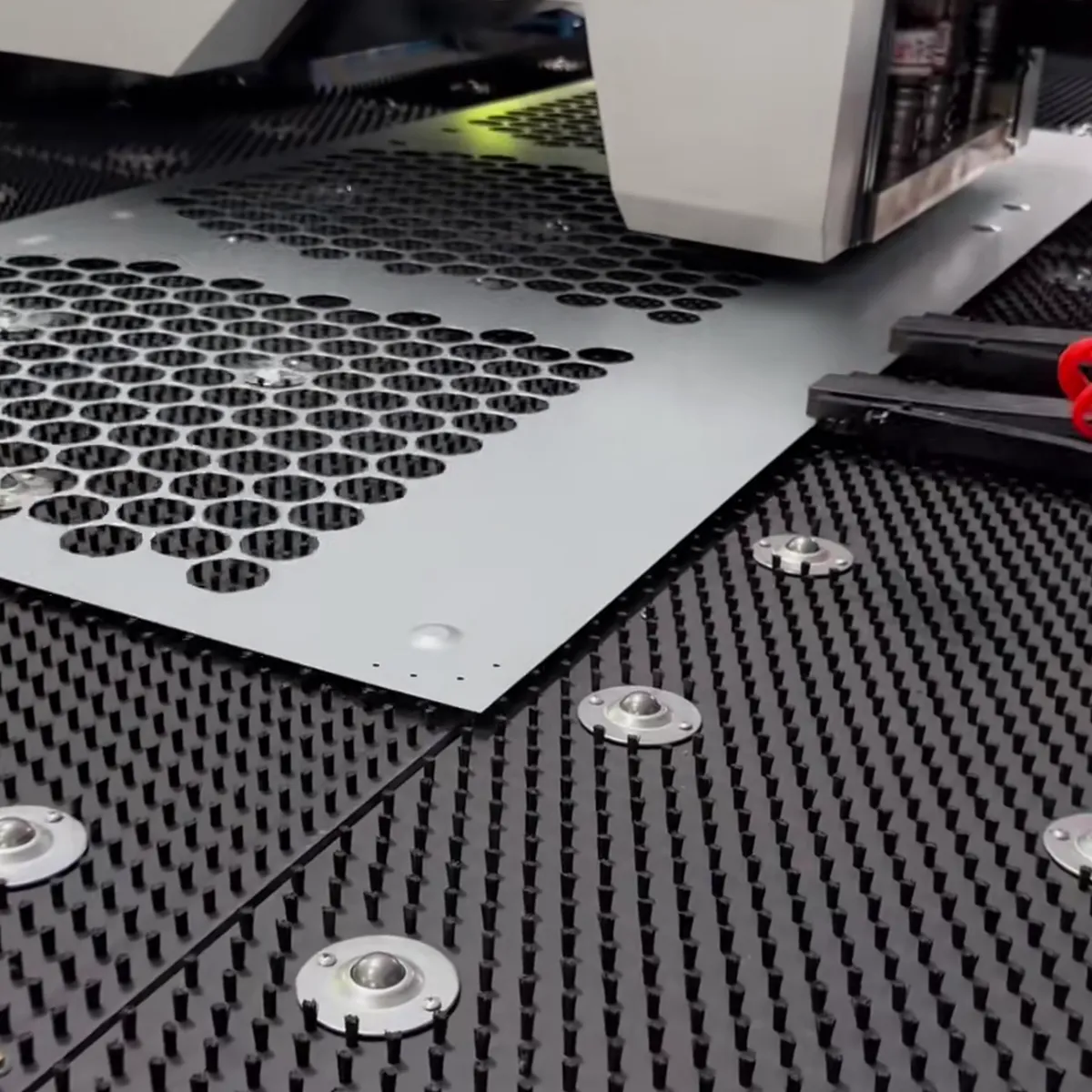
A repeated panel contained dense holes, slots, and formed details that needed an economical production route.
Classify features, use standard tools where possible, plan clamp-safe nesting, approve first-off features, and monitor tool wear.
Documented DFM findings, a proposed manufacturing route, quotation, and lead-time plan for your approval.
Punching questions
Answers about feature rules, tooling, and when punching fits better than laser cutting.
Punching can be attractive for repeated standard features, high hit counts, formed features, or volumes that benefit from fast cycles. Laser cutting may fit complex contours or frequent low-volume geometry changes better.
Yes when a suitable forming or marking tool is available and the sheet, feature spacing, and downstream process permit it. Tool availability should be confirmed during quotation.
Very small holes, dense perforations, narrow webs, edge-near features, tool wear, and heavy forming loads can affect flatness or local geometry. The pattern should be reviewed before release.
A sheared edge normally has a burr side, and forming tools may leave witness marks. Burr direction, cosmetic faces, deburring, and surface protection should be specified.
No. Standard tools, combinations of hits, or another process may avoid custom tooling. The best choice depends on geometry, edge quality, quantity, cycle time, and acceptable witness marks.
Balanced pattern layout, adequate edge margins and webs, suitable hit sequence, sharp tooling, intermediate leveling, and realistic flatness criteria can help. The achievable result depends on material, thickness, open-area ratio, and panel size.
Punching DFM
Punching economics depend on standard tools, adequate material around each feature and a layout that avoids weak webs or distorted edges.
View the complete sheet metal DFM guideStart near D >= t for mild steel and prefer D >= 1.5t for stainless steel.
Use clear edge distance >= 1.5t and clear hole-to-hole web >= 2t as review starting points.
Reuse standard round, obround and rectangular tools to limit special tooling and press setups.
Customer Perspective
B2B customers often give brief, practical feedback and show their trust through the next project.
Selected customers
Full production programs, repeat orders, and multi-year supply — not one-off samples. References available for your sector on request.
In contract manufacturing, the clearest reward is often another drawing, another production order, or a larger scope.
We do not publish a customer's name, product, drawing or project details without written permission. That is not a lack of proof - it is how contract manufacturing works, and it is the same discretion we apply to your designs.
Send your drawings and requirements for an engineering review, project-specific quotation, and manufacturing plan.