Powder Coating vs Wet Painting vs Anodizing: Which Sheet Metal Finish Should You Choose?
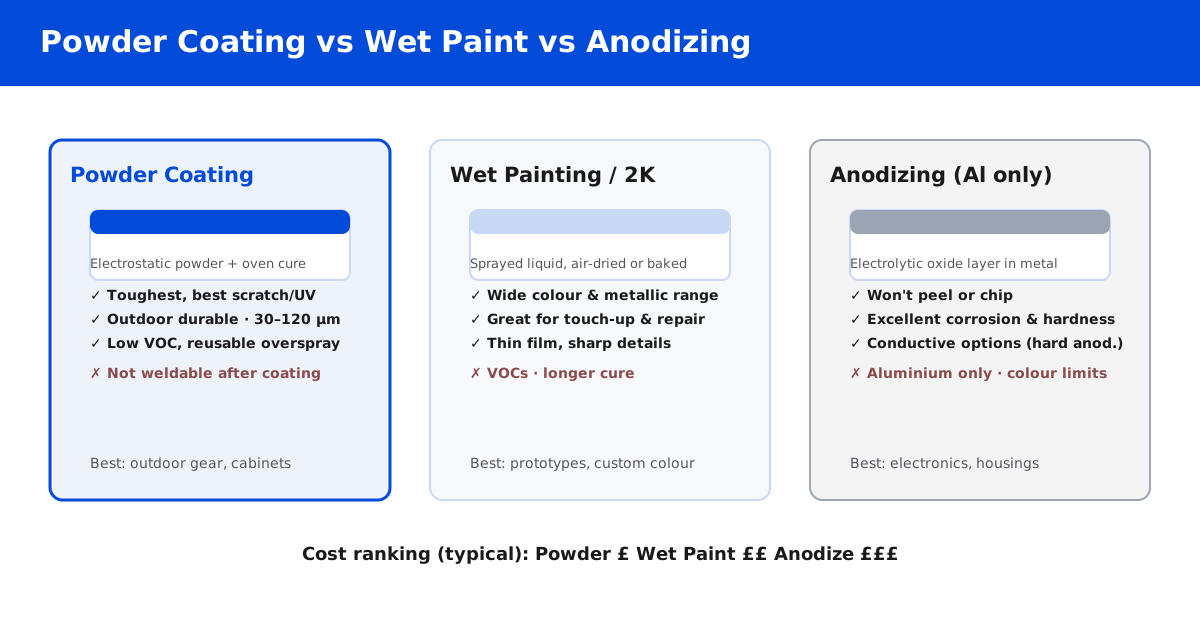
Powder Coating vs Wet Painting vs Anodizing: Which Sheet Metal Finish Should You Choose?
The finish you pick changes how a part looks, how long it lasts outdoors, and how much it costs. It is also where a lot of projects go wrong — usually by picking a nice-looking finish that doesn’t survive the environment, or an over-engineered one that blows the budget.
Here is an honest comparison of the three most common sheet metal finishes, with real guidance on when each one is the right call.
The three finishes at a glance
| Feature | Powder Coating | Wet Painting (2K) | Anodizing |
|---|---|---|---|
| Material | Steel, Aluminium | Steel, Aluminium | Aluminium only |
| Film type | Baked powder, 30–120 µm | Liquid, 15–40 µm | Oxide grown into the metal |
| Can it peel / chip? | Hard to chip | Can chip | Won’t peel |
| UV / weather | Excellent | Good | Excellent |
| Weldable after? | No | No | N/A |
| Colours | Huge range, few constraints | Widest, incl. metallic | Limited range |
| Typical cost | Low–Med | Med | Med–High |
How each one actually works
Powder coating
Dry powder is sprayed electrostatically and then baked in an oven, where it melts and fuses into a continuous film. No solvent leaves the film, which is why it is robust and low-VOC.
Strengths:
- Toughest film of the three, with excellent scratch and impact resistance
- Great outdoor and UV performance
- Very repeatable colour and coverage
- Overspray can be recovered, so waste is low
Limits:
- Not weldable or easily touched up after coating
- Sharp edges can look thinner (the “ghost line” effect at radii)
- Requires careful surface prep (degrease, and often phosphate or zinc primer)
Wet painting / 2K (two-pack) paint
Liquid paint is sprayed and cured by air-drying, low-baking, or with a hardener. It is the most flexible finish for custom colour and for matching an existing part.
Strengths:
- Widest colour, metallic, and effect range
- Thin film keeps fine details sharp
- Easiest to touch up and repair on site
Limits:
- Contains VOCs, so it needs handling and space
- Softer than powder — chips and scratches more easily
- Longer cure times slow production
Anodizing (aluminium only)
Anodizing grows an oxide layer in the aluminium, so the finish is part of the metal. It does not peel or chip because there is no separate film to lose.
Strengths:
- Excellent corrosion and wear resistance
- Electrically insulative (or conductive with a hard-coat variant)
- Keeps dimension and detail crisp
- No coating to scratch off
Limits:
- Aluminium only
- Limited colour palette (natural, black, and a few tones)
- Hard anodizing adds thickness, so it changes fitted dimensions
- More expensive, especially on complex parts
Which finish is right for you?
Use a decision tree rather than a guess:
Choose powder coating when
- The part lives outdoors and sees UV, rain, or abrasion
- You need a tough, consistent film on steel
- You’re making cabinets, enclosures, racks, brackets, or equipment housings
- You want a repeatable finish at a sensible cost
Choose wet painting when
- You need a specific colour match (brand colour, RAL, Pantone)
- You want a metallic or custom effect
- You’re painting prototypes or short runs and colour flexibility matters more than hardness
Choose anodizing when
- It’s an aluminium part in electronics, optics, or precision equipment
- You need a finish that won’t peel and stays dimensionally crisp
- The surface is decorative, hard, or needs to be semi-conductive
A note on cost that people skip
Cost ranking for a typical part is roughly:
Powder < Wet paint < Anodize
But the total landed cost is more than the finish itself. Surface prep, masking, the number of coats, and handling all add up. A simple powder coat on an enclosure is usually the cheapest way to get a durable, professional outside surface.
High-end anodizing looks cheap per unit until you add hard-coat thickness, tolerance checking, and masking for features you want to keep bare.
How to specify a finish so you don’t get burned
Write the finish down in a spec, not just in an email.
- Material + thickness — some finishes don’t work on some alloys.
- Finish type — powder, wet, or anodize.
- Colour — a real code (RAL, Pantone) or a physical sample.
- Film thickness — e.g. “powder ≥ 60 µm” or “anodize 20 µm.”
- Exposed vs masked areas — threads, bearing seats, or welds you need to keep bare.
- Surface prep standard — e.g. zinc phosphate before powder, or anodize on machined (not cast) aluminium.
FAQ
Can you paint over powder coating?
Not reliably. Powder is hard and smooth, so you must scuff it carefully. It’s better to choose the finish once and commit.
Does anodizing change the size of the part?
Yes — anodizing grows outward by roughly half the oxide thickness. On fitted parts, allow for it or mask the mating surfaces.
Is powder coating good for outdoor use?
Yes. A properly prepped powder coat with a suitable primer is one of the best choices for outdoor sheet metal, especially on steel.
What’s the cheapest durable finish?
Usually a single-layer powder coat on mild steel with the right primer. For tin-walled precision parts, wet painting is sometimes cheaper because of the lower coating cost.
Related reading:
- Sheet Metal Finishing Services: Techniques and Applications
- Sheet Metal Powder Coating: Techniques and Applications
- Choosing Sheet Metal for Outdoor and Corrosive Environments
The right finish depends on your material, environment, and budget. If you’re deciding between finishes, tell us the environment the part will live in and we’ll recommend a spec that meets it without over-spending.