Laser vs Plasma vs Waterjet Cutting: Choosing the Right Process for Your Part
Laser vs Plasma vs Waterjet Cutting: Choosing the Right Process for Your Part
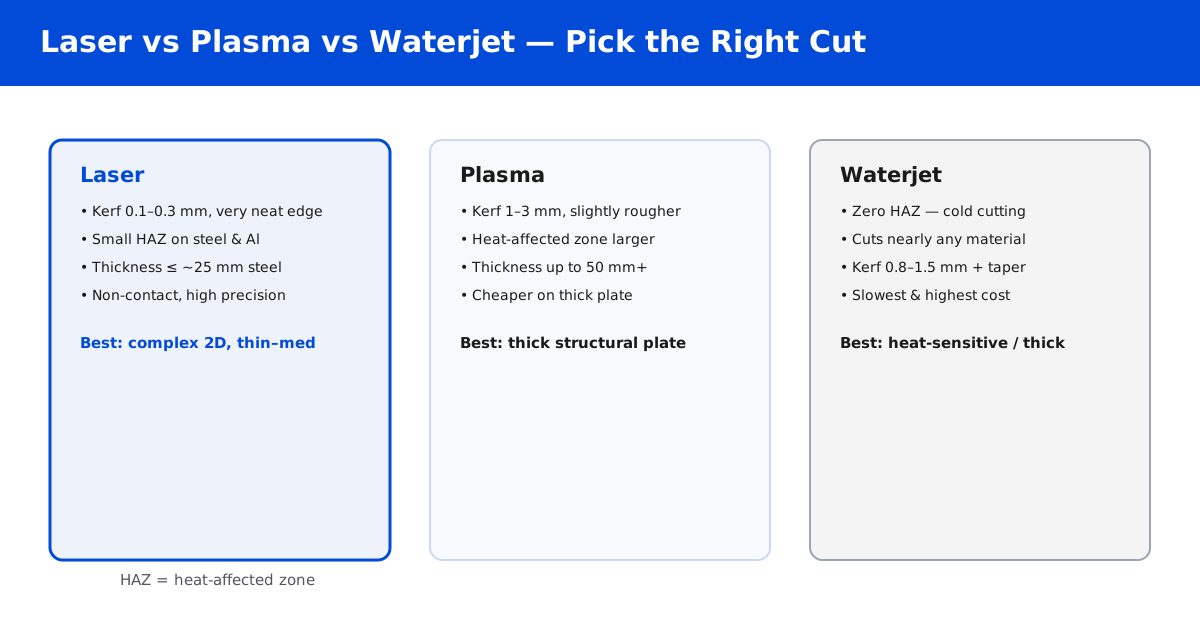
The way you cut a part affects its accuracy, edge quality, cost, and what happens to the material around the cut. There are three main thermal / non-thermal processes for sheet metal, and each has a sweet spot.
Here’s a straight comparison so you can pick the right one for your thickness, material, and budget.
The three processes at a glance
| Process | Typical thickness | Edge quality | Heat input |
|---|---|---|---|
| Laser | ≤ 25 mm steel | Clean, precise | Small heat-affected zone |
| Plasma | 10 – 50 mm+ | Slightly rougher | Larger heat-affected zone |
| Waterjet | Any (up to ~200 mm) | Smooth, no heat | None (cold) |
How each process works
Laser cutting
A focused laser beam melts or vaporises material along a clean line. It’s the default for thin-to-medium sheet metal and complex, precise profiles.
Strengths:
- High accuracy, narrow kerf, neat edge
- Small heat-affected zone — good for materials that are finicky about heat
- Fast on thin and medium material
- Ideal for precise geometric profiles
Limits:
- Thickness limit (~25 mm steel, less for aluminium)
- Reflective materials (copper, brass) can be tricky
- Thermal — not ideal for highly heat-sensitive parts
Plasma cutting
An electrically ionised gas (plasma) cuts through metal. It’s the workhorse for thick plate and structural steel.
Strengths:
- Great on thick material (10 mm and up, sometimes 50 mm+)
- Faster than laser on heavy plate
- Lower equipment cost on thick sections
Limits:
- Wider kerf, slightly rougher edge
- Larger heat-affected zone
- Requires more clean-up (dross, rougher edge)
Waterjet cutting
A high-pressure stream of water (with abrasive for hard materials) erodes the material. It cuts cold.
Strengths:
- No heat — zero heat-affected zone
- Cuts almost any material (metal, stone, composites, glass)
- Very thick material, smooth edge
- No thermal distortion
Limits:
- Slowest and most expensive
- Abrasive adds cost and waste
- Slight taper on thicker cuts
- Needs a water treatment setup
How to choose
Choose laser when
- Your part is thin to medium (roughly ≤ 20 mm steel, ≤ 12 mm aluminium)
- You need tight precision and a clean edge
- The part has complex, detailed profiles
- You want a fast, cost-effective cut
Choose plasma when
- The material is thick plate (10 mm+)
- It’s a structural / functional part where a slightly rougher edge is fine
- You want speed and lower cost on heavyweight sections
Choose waterjet when
- The part can’t handle heat (heat-sensitive or hardened material)
- The material is very thick or exotic (titanium, glass, composites)
- You need a smooth edge with no heat-affected zone
The hybrid reality
Most fabrication shops don’t run just one process — they run the right one for each layer of the job. For many projects you’ll get the best of both:
- Laser the precise, thin profiles
- Plasma or waterjet the heavy plate
- Then press-brake the bends and weld it all together
That’s how you get cost and quality at the same time.
The cost trade-off in one line
- Thin, precise, high-volume → laser is usually cheapest
- Thick, structural → plasma is often cheapest
- Thick, heat-sensitive, exotic → waterjet, even though it costs more
If your part fits the “thin and precise” bucket, laser is almost always the right call. If it doesn’t, don’t force it.
FAQ
Is laser cutting best for sheet metal?
For most sheet metal parts — thin to medium, complex, precise — yes, it’s the default. For thicker plate, plasma or waterjet wins.
Does laser cutting heat the metal?
Yes, it creates a small heat-affected zone. Usually fine, but for heat-sensitive material or very precise edges, waterjet (cold) is safer.
What’s the cheapest way to cut thick steel?
Plasma is typically the most economical for thick structural plate.
Can waterjet cut anything?
Almost — that’s its strength. It cuts metal, stone, glass, composites, even rubber. Just not as fast or cheap as laser for thin sheet.
Related reading:
- CNC Machining vs Laser Cutting: Which Process Should You Choose?
- Sheet Metal Laser Cutting: Technology and Applications
- How to Design for Sheet Metal Fabrication (DFM)
If you’re not sure which process fits your material and deadline, send us the drawing and we’ll recommend one — and quote the right price for it.